Thursday, March 6, 2008

A delicious meal: pupusas

One of our assignments this week was to make a delicious meal. Unlike many of my classmates, I am not much of a cook, and I knew I wouldn't get away with pulling something out of the freezer and sticking it in the microwave. I thought long and hard about what I could make that wasn't boring, and I decided to make pupusas. Pupusas are a Salvadoran food, and they are basically filled tortillas, usually with cheese, sometimes with beans, meat, or other fillings. They are delicious, and I had them at least once a week while I was in El Salvador. I had only made pupusas once before, under heavy supervision and help from a Salvadoran woman, so the process was a bit of a challenge, but I managed. Taking photos throughout the process was also a challenge, because my hands were usually covered in masa dough.

There are only three ingredients in these pupusas: masa, beans, and cheese. Masa is just ground up corn (what corn tortillas are made out of). In El Salvador they have a special soft cheese for pupusas, but I'm not even sure what it's called, so I used mozzarella.

My ingredients:

Maseca
I already had this Maseca (dry masa), which I got at a store called Mi Tierra in Berkeley.

beans
There is no exciting story behind this can of beans. I bought it at Haight Street Market (only because I happened to be on Haight Street). Note that it is vegetarian because most refried beans have lard (yuck).

cheese
The cheese has the same story as the beans.

And this is how I made the pupusas:

First step: prepare the masa. I mixed some Maseca with water to make the dough. I had to add a little more water than the packaging said to make it the right consistency.


Second step: make the pupusa. First you roll a hunk of masa into a ball.


Then you flatten it into something like a bowl-shape, using a circular motion with your hands to keep it even and round (this is pretty hard, and I definitely don't do it the "right" way). This photo is not a great example of how it should be, but you get the idea:


Put a little bit of beans and cheese in the middle and fold up the sides of the masa to make a closed ball again.


Then you want to flatten that ball, patting it back and forth between your hands.


You have to be careful not to put too much beans, or the masa will break open very easily (which happened to me a lot). When you're handling the masa, you have to wet your hands frequently to keep the dough from sticking to your skin (much).

Third step: cook it. I wasn't sure what temperature to have the pan or how long to cook it, so I improvised. It takes a long time for the masa to cook all the way through, which definitely tested my patience.


Cooked pupusas:


I cut up some cherry tomatoes and made a bit of simple guacamole (avocado, lemon juice, salt) to go with the pupusas, and it was all very delicious.


They weren't the same as authentic pupusas, but for gringa pupusas they were pretty yummy!

Andrea liked them:


And so did Melanie:


Overall, it was a delicious success.

Global Good Neighbor Principles

I'm writing a paper about the representation of immigration in news media for my Globalization and International Media class, and I ran across this in an article I'm reading. It seems like very sound advice for the U.S. government:

Global Good Neighbor Principles

Principle One: The first step toward being a good neighbor is to stop being a bad neighbor.

Principle Two: Our nation's foreign policy agenda must be tied to broad U.S. interests. To be effective and win public support, a new foreign policy agenda must work in tandem with new domestic policies to improve security, quality of life, and basic rights in our own country.

Principle Three: Given that our national interests, security, and social well-being are interconnected to those of other peoples, U.S. foreign policy must be based on reciprocity rather than domination, mutual well-being rather than cutthroat competition, and cooperation rather than confrontation.

Principle Four: As the world's foremost power, the United States will be best served by exercising responsible global leadership and partnership rather than seeking global dominance.

Principle Five: An effective security policy must be two-pronged. Genuine national safety requires both a well-prepared military capable of repelling attacks on our country and a proactive commitment to improving national and personal security through non-military measures and international cooperation.

Principle Six: The U.S. government should support sustainable development, first at home and then abroad, through its macroeconomic trade, investment, and aid policies.

Principle Seven: A peaceful and prosperous global neighborhood depends on effective governance at national, regional, and international levels. Effective governance is accountable, transparent, and representative.

(Source: "U.S. Hegemony or Global Good Neighbor Policy?" by Laura Carlsen and Tom Barry, IRC Americas Program)

Wednesday, March 5, 2008

Global Women's Rights Forum: Stop Firestone Campaign

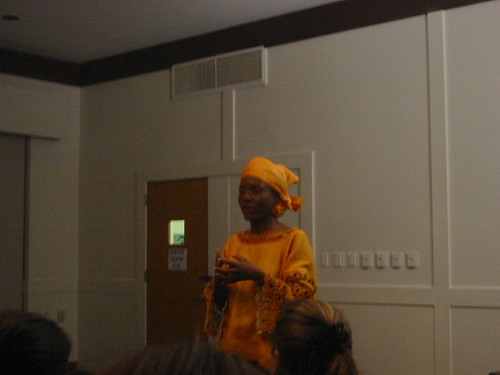
Tuesday evening, as part of the Global Women's Rights Forum at USF, Emira Woods from the Institute for Policy Studies, spoke about Firestone's exploitation of workers and the environment in Liberia, and the movement stop it.


Firestone (the company that makes tires), is the largest foreign investor in Liberia. They have a quota system, and if their workers do not collect the required amount of rubber, they don't get paid. The amount is unachievable (and the pay tiny), so women and children come to help their husbands/fathers. This means that Firestone is getting free labor from women and children. They are also dumping lots of toxins and wreaking environmental havoc on the community. You can find a lot more information at StopFirestone.org.

The really cool thing is that there is that the workers and community members are organizing for change. The movement is a global collaborative effort, but fundamentally, it is coming from the people of Liberia who are most effected by Firestone's abuses. This is essential (read Pedagogy of the Oppressed), and I was happy to hear both the speaker and members of the audience emphasize the importance of this point.

I also loved her hopefulness. I've spent a lot of time studying all the things that are wrong in the world, and it can be really discouraging. I sometimes forget that by knowing everything I do, I am empowered to make the change I know needs to happen.

Best and easiest blogging and photo tools

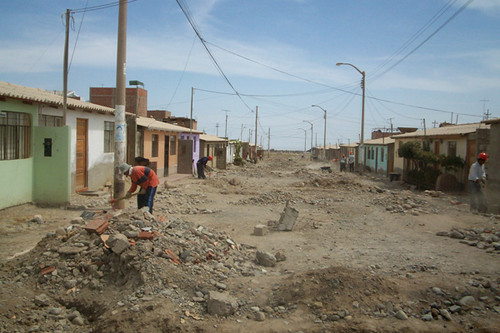
I have a question for all my digitally literate friends. In May, I will be going to Tacna, Peru with a group from USF (mainly computer science, and some dance people). We'll be serving a few schools down there, and one activity we want to do with the kids will be digital photography and blogging. Last year they did something similar to what we want to do this year, and they used Flickr for photos and Vox for blogging. When I tried Vox a year or two ago I didn't like it because you had to be a member to comment. I don't know if they've changed that, but my inclination is to use Blogger because that's what I've always used. My inclination is also to use Flickr, because it's what I'm most familiar with. However, there are other tools out there that may be better or easier. I looked at Picasa (Google's photo site), and it seems simpler to use than Flickr, though maybe less powerful. It would also probably make the kids' photos less visible because it isn't nearly as well-known as Flickr. For me, that's significant. I also tried poking around WordPress, and it seems more or less equivalent to Blogger (with an emphasis on open source, which is awesome). Does anyone have thoughts on Flickr vs. Picasa and Blogger vs. WordPress?

Here's an photo one of the kids took last year:

Tuesday, March 4, 2008

Bryan Alexander at USF

As usual, everything took longer than it was supposed to today, and I'm afraid I can hardly do justice to Bryan Alexander's talk last Thursday, but I'll write what I can now (before class starts) and write some more later.

Bryan Alexander works for NITLE, focusing on use of technology in education. This is completely interesting and awesome. He talked about some of the great collaborative tools in Web 2.0, including collaborative writing and collective research. He said that there is a shift in the model of learning from individual experts to learning through networks (connectivism). This reminded me of this article on categorization and tagging, which describes the limitations of structured, institutionalized categorization (as we have in libraries), and some of the ways that tagging can change this. I have more thoughts on this article, which I will talk about later, but it's the same concept of collective creation.

I think the use of these tools is really exciting, and the formats of collaboration could really transform our culture. If people begin to feel empowered in their education, it's a different dynamic than the "sit down and do as you're told" model.

Monday, March 3, 2008

Does Religion Cause War? Panel event

Another cool-looking event at USF:

"Does Religion Cause War?"

A panel discussion
March 6, 2008
Xavier Room, Fromm Hall, 5:00-6:00 p.m.

featuring

Stephen Zunes, Politics
Vincent Pizzuto, Theology and Religious Studies
Anne Bartlett, Sociology

moderated by John Nelson, Theology and Religious Studies


It is a sobering fact that a majority of students at USF and universities elsewhere have lived half their lives in the climate of war. This panel discussion will investigate whether it is credible to claim, as have bestselling authors like Richard Dawkins in The God Delusion (2006), that religion is a direct cause of war and violence. Ways in which religious motivations can be steered into conflict, whether “fundamentalist” forms of religion are prone to violence, and whether teachings of peace within a religion can constrain the belligerent tendencies of its adherents will all be considered.

Sponsored by the Department of Theology and Religious Studies

Zunes is awesome, and I've heard great things about Pizzuto, including that he's attractive (extra bonus!). I don't know anything about Anne Bartlett.

Gcast: easy podcasting

I'm holding off on my entry about Bryan Alexander's excellent talk until I've uploaded my photos, but in the meantime I thought I would write about Gcast. Gcast is a tool which allows you to easily create and upload podcasts. I am taking Spanish Conversation this semester, so instead of weekly written assignments, our professor has us do "audio blogs" either about our weekly cultural/linguistic activity, or in response to a prompt she has given us. You can find my broken Spanish aquí. En la ultima entrada, hablé sobre Tacna, Peru, y lo que aprendí de Wikipedia en español.

The thing I really like about Gcast is that it's very accessible. Podcasting sounds intimidating, but Gcast allows you to call a toll-free phone number to record your podcast. You don't need to download special audio software or anything. This is especially useful when the recording needs to be done by 5:00, and it's 4:50 and I'm nowhere near my computer. Of course, if you want, you can also upload an audio file from your computer. One drawback with using the phone is the sound quality is pretty poor (making my Spanish especially hard to understand), but depending in how you're using it, it's good enough.

Human Rights Film Night

These films look great:

2008 Human Rights Film Night

March 10
Presentation Theatre
2350 Turk Blvd. at Masonic Ave.

5:00pm
Father G and the Homeboys

Father G and the Homeboys chronicles the lives of 4 Latino gangbangers as they redirect their lives in a wartorn area of Los Angeles known as Boyle Heights, at one time, the street gang capital of the world. For over 20 years, Father Gregory Boyle (Father G) and his non-profit organization, Homeboy Industries, have helped kids plan for their futures instead of their funerals.

7:00pm
For the Bible Tells Me So

Can the love between two people ever be an abomination? Is the chasm separating gays and lesbians and Christianity too wide to cross? Is the Bible an excuse to hate? Dan Karslake’s provocative, entertaining documentary brilliantly reconciles homosexuality and Biblical scripture, and in the process reveals that Church-sanctioned anti-gay bias is based solely upon a significant (and often malicious) misinterpretation of the Bible.

This event is free and open to the public. Sponsored by the Center for Latino/a Studies in the Americas, the Joan and Ralph Lane Center for Catholic Studies and Social Thought, the Latin American Studies Program, the LGBTQ Caucus, and University Ministry.

Monday, February 25, 2008

Brewster Kahle at USF

Brewster Kahle gave an excellent talk at USF last Thursday as part of the Davies Forum. His mission is universal access to all knowledge: he wants to create a library like the (former) library of Alexandria, but digitized and online. He showed us, medium by medium, that this it is doable and not crazy to think we can digitize all texts (in the broad sense). The Internet Archive is that library, which stores hundreds of thousands of digitized books (and other written texts), audio files, moving images, web pages, and software. He successfully convinced me that it is possible, but I still don't know if open content (which the Internet Archive promotes) can beat Google (which uses proprietary formats).

I am excited about all the Old Time Radio files they have. I love OTR. It's engaging on an entertainment level and fascinating on a historical level. Lots of cigarettes and war and blatant sexism. The mysteries are the best.

But back to the talk, he answered the question I posed in an earlier blog post (about how easily digital media can be erased) without me even having to ask it. They back up all their stuff on servers far far away (in Alexandria!), so when a giant earthquake puts San Francisco underwater, the Internet Archive will still exist. Excellent.

Sunday, February 24, 2008

St. Anthony Foundation visit to USF

On Friday I had the privilege of spending a bit of time with a group of staff and clients from the Employment Program/Learning Center at St. Anthony Foundation. The Office of Service-Learning and Community Action, where I work, invited them to come. So many USF students serve at St. Anthony's that my office wanted to give the people at St. Anthony's a chance to see where the students come from and hear why they do service. I gave them a tour of the USF campus and was part of a panel with two other ACEs, talking about what we've learned from our service experiences. One of our main focuses was the community as educator. They teach students just like professors do.

On the panel we were talking about how much we enjoy doing service, and one of the men from St. Anthony's said he eats in the dining room there regularly, and he's noticed that USF students always look like they're enjoying themselves. He said it's really nice just to see happy people, and that it's a blessing to have them there.

Remember to smile at people, no matter who they are or whether you're having a bad day, because you might be the only smiling person they see that day.